
NO BORDER
In Greece : the machine to criminalize people on the move
An Interview with the group de:criminalize
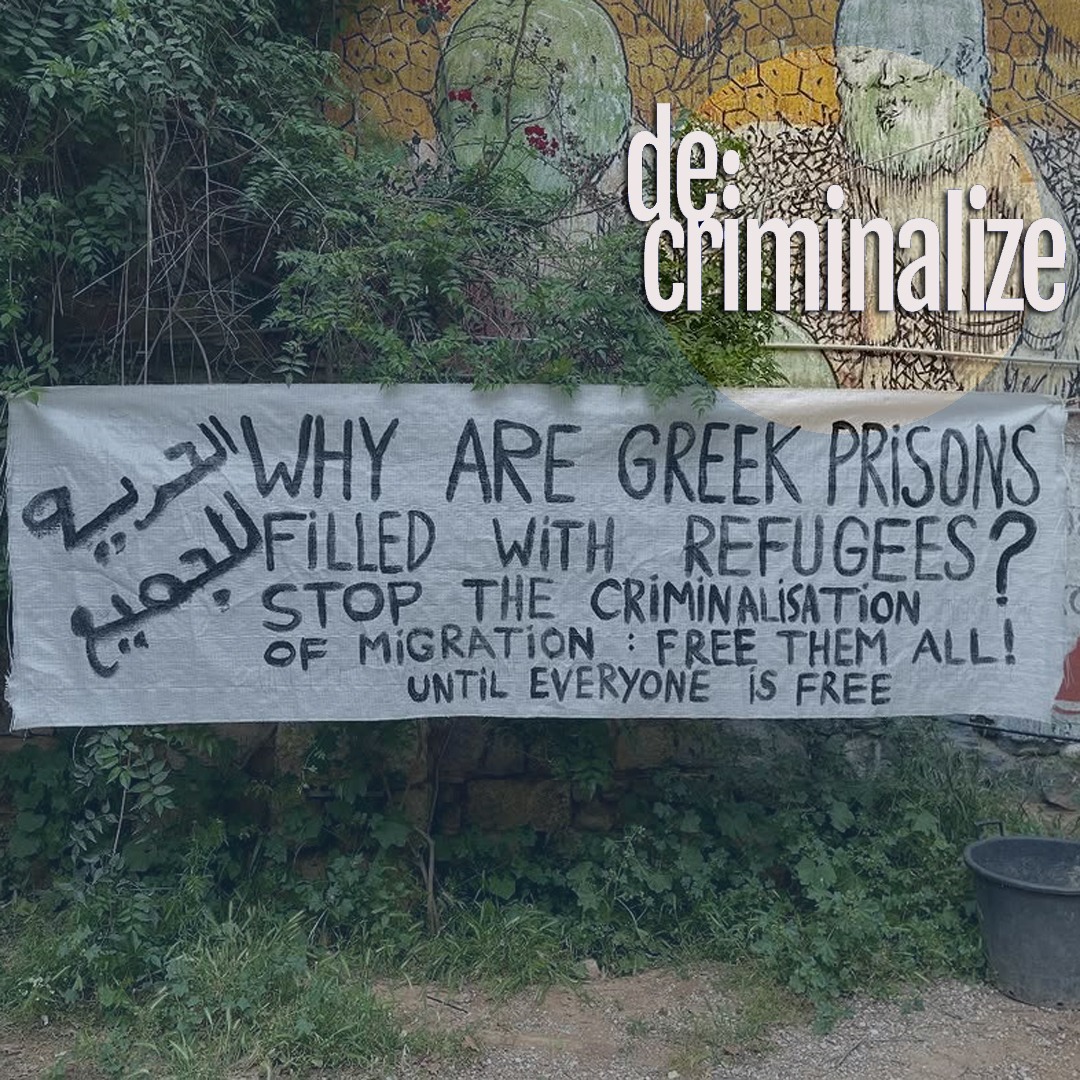
In Greece, since the mid-2010s, the criminalization of migration has steadily intensified. One of the cogs of this repressive system is the fight against alleged "smuggling." Because they were forced to steer the boat, because they were near the bow, because they used a GPS, or simply because they were on board and identified - some of them still underage young men - they are accused of being smugglers, often solely on the basis of the Greek coast guars’’ testimony. They are treated as if they were part of a mafia or involved in terrorist activities. Held in pretrial detention under extremely harsh conditions, their fate is decided in a trial which lasts a few minutes and will either acquit them or condemn them to staggering prison sentences. This appalling system of exceptional justice, championed successively by far-right Ministers of Immigration and Asylum, systematically scapegoats one or more individuals and establishes a regime of carceral terror in lieu of migration policies. After the traumas of war, genocide, life under dictatorship, and migratory journeys often marked by multiple forms of violence, particularly in Libya, and perilous crossings, a supposedly safe and democratic country criminalizes exile on a massive and industrial scale. The context of the "asylum crisis" in Greece in the mid-2010s had made it easier to pass measures(at the behest of Europe) that infringe upon rights and freedoms, as well as the rule of law. Initially considered temporary, these measures have become permanent and are now part of the "migration management" models within a European Union that continues to expand the scope of detention and deportation policies, as evidenced by the recent vote on the "Return" regulation. Founded in 2024, the Berlin-based organization de:criminalize emerged from Borderline Europe's working group against criminalization. It assists people on the move that are criminalized in Greece and elsewhere - by providing them with the legal means to defend themselves as well as the material means to survive during incarceration. The organization also works to debunk the propaganda legitimizing a repressive system that grievously violates human rights. In february we have met with Florentine to learn more about the work and actions of de:criminalize .
This interview is also avaiblable in a translated French version.
How would you like to introduce yourself?
My name is Florentine, and I am part of the mostly Berlin-based group de:criminalize. I am one of the newer members of the group and have so far mostly contributed to case work and campaigning.
How did you come to join de:criminalize ?
I've been active in No Border struggles for a long time, and joined de:criminalize when I moved to Berlin. It is a relatively small group of just about ten people, most of whom — but not all — live in Berlin. De:criminalize evolved out of the anti-criminalization working group of Borderline Europe, an NGO with offices in Berlin, on Sicily and on Lesbos that advocates for the rights of people on the move. As the work developed, it became clear that supporting individual cases of criminalization, especially in the context of smuggling accusation, was difficult to carry out within the existing structure of Borderline Europe. For this reason, we founded de:criminalize as an independent group.
What were the initial objectives when de:criminalize was funded? And what resources did the organization have?
Our objectives were and are the fight against the European border regime, and particularly its criminalization of people on the move who are accused of ‘smuggling.’ The slogan “fight borders, not smugglers” captures it quite well. We support people who face criminalization for migrating themselves or for having assisted others to migrate, and our goal is to change the political narrative around so-called ‘smuggling.’ We fight for the freedom of movement for all, acknowledging that the current practices of the European border regime and this massive incarceration of people on the move are a continuation of colonial practices. This injustice has devastating consequences for those accused and imprisoned, yet it receives little media attention.There have been some cases in which Europeans supporting people on the move were criminalized, and these have often attracted more media coverage than the widespread incarceration of migrants themselves. One of our goals is therefore to raise public awareness of these overlooked cases and to challenge the simplistic narrative that separates the ‘good migrant’ from the ‘bad smuggler.’ We try to show that we are looking the wrong way, and that, for instance, the EU-funded Libyan Coastguard would be a good example for an organization that actually benefits from the militarization of the European borders.
Regarding resources, we have benefitted from a large donation from the ecologist and activist Carola Rackete, and we have been cooperating with the NGO Medico international on the Freedom of Movement Fund, which has allowed us to support a number of cases. Other than that, we depend on individual donations and do fundraising campaigns and events. Our work is strengthened by our active role within a transnational network of organizations across multiple countries, including the Legal Center Lesvos, Captain Support, Mobile Info Team, Proyecto Patrones and many others.
Before delving deeper into the issue of the current criminalization of people on the move, could you explain what major developments in the Greek judicial system have led to the current situation?
It is important to see the Greek legislation in the context of the European EU legislation. The EU has made the so-called ‘fight against smuggling’ a top priority since 2015, and there are a lot of resources going into this policy goal. It has become a key task of the European Border and Coast Guard Agency Frontex. Part of these efforts consisted in defining the borders of Greece as external borders of the EU and heavily militarizing them. Since then, the EU steadily increased those resources, and Greece has been facing pressure to intensify its efforts. The legislation behind this is contained in the European Facilitator’s Package. It has first been established in 2002 and currently an even harsher reform is being discussed. It contains only a very vague definition of the term ‘smuggling’ and, unlike the UN Protocol on Smuggling, does not require the existence of ‘financial gain’ in order to be considered a crime, nor includes an exemption clause for ‘humanitarian assistance’ or family members. This creates a lot of legal ambiguity and leeway for interpretation.
For the situation Greece, we did a study in 2023 “A legal vaccum”, which some of us carried out while we were still working as part of Borderline Europe’s internal structure. The study examined 81 trials across eight different locations in Greece.The Greek laws on immigration and ‘smuggling’ have been tightened over the past three decades. It is very broad: for instance, migrants don’t even have to act for profit, be part of an organized criminal group, or present any risk to the safety of the people they transport in order to be prosecuted as a ‘smuggler.’ This leads to a great number of arbitrary detentions. Also, the Greek law by now treats each case of a person being transported as an individual case, which results in very high prison sentences for the people convicted for ‘smuggling,’ with an average sentence of 46 years.
But not only is this law formulated vaguely enough to allow for arbitrary accusations, also the way it is implemented systematically violates the rights of the accused. Boat or car drivers are routinely accused with very little attention to their intentions or actual involvement : just steering the boat or assisting the driver can lead to criminalization, even if this occurred in an emergency situation or under threat of force. Even minor acts, such as helping with navigation or sharing food, can result in accusations. Our study found that, as of 2023, the people convicted of smuggling were the second largest group of people in Greek prisons, 90% of them being third country nationals. In a great number of cases, people are illegally put in pre-trial detention for an average of eight months. By now, these trials have become a routine process in Greek courts, with an average duration of just 37 minutes, raising serious concerns about compliance with fair trial standards. Fundamental rights are frequently undermined. In many cases, there is no qualified interpreter or proper translation, and defendants are represented by state-appointed lawyers who often meet them for the first time on the day of the hearing. The proceedings are often marked by weak or insufficient evidence, while reports also point to violence during arrests. At the same time, particularly vulnerable individuals are not adequately protected. For example, minors are frequently treated as adults. Defendants are also pressured into accepting plea deals without a clear or informed understanding of the consequences.
Would you say that if, for example, a group of people crosses the border today, one or more of them will inevitably be detained—that it’s systematic?
Yes, that is pretty certain.
How and where are people incarcerated? What are the conditions under which they're incarcerated?
People accused of smuggling are usually incarcerated in regular Greek prisons. If a minor is tried as an adult, they will also be placed in an adult prison facility. The conditions in Greek prisons have been criticized by many independent human rights observers and reports; they are often overcrowded, fail to provide medial support, people are often isolated as they do not have access to contact with family members or friends (phone calls are paid), several people have reported abuse and torture at the hands of Greek police in detention and during arrests.
Another human rights violation that has been documented on a regular basis is, as I already mentioned, that they are not provided adequate legal counsel in their own language or facilitated by a translator. In these situations, our task is not only to bring them in touch with a lawyer, but also to support them in maintaining contact with friends and family members.
One of my next question was, how does de:criminalize get in contact with the people and at what moment ?
We are often contacted by people who have been accused of ‘smuggling’ themselves, or by their friends or relatives who find our contact through instagram or our media work. We also learn about many cases through the network of partner organizations I mentioned earlier, and discuss our possible means of support with them.
I understand that you are not able to know about everyone. How many people, would you say, you are able to help?
This question is hard to answer. We have limited funds and have to abide to relatively strict administrative and legal regulations in our work, which implies that we work in cooperation with the system we are trying to oppose. For example, in order to support one case in Greece, the lawyer and court fees alone require a contribution of about 1,500 Euros to cover these obligatory costs, while appeal trials can be even more expensive. Because of these conditions, we also provide practical support. This includes helping those imprisoned with essential needs such as phone cards, shoes, and clothes, and assisting family members or witnesses to attend trials by covering their travel and other expenses.
Do you have certain lawyers that you often work with ?
Yes, there are a number of lawyers we know and often cooperate with. A reliable network of experienced lawyers is crucial, because effective defense requires that lawyers grasp the structural context of these criminalization cases and can draw on past court rulings that supported the accused.
How can people help de:criminalize, can they donate money ?
Yes, donations are possible and essential, especially long-term regular donations are very welcome. We have a non-profit status. Other than that, working together to subvert the public discourse around migration and ‘smuggling’ by attending events and sharing information on these issues is very important.
Which countries do most people accused of ‘smuggling’ come from ? I have the impression that there are a lot of people coming from Sudan.
Recently, especially because of the war, many Sudanese people have been arriving on the island of Crete. As a result, a large number of Sudanese, particularly young people between the ages of 15 and 21, have been arrestedThis has led to cooperations of de:criminalize with Sudanese activist groups like Sudan Uprising Germany and a network based in Greece called “50 out of many and Mataris Sudanese Self organization” in which also many Sudanese people are active. But we also support people on the move from many other countries, like Syria, Turkey, Egypt, or Palestine.
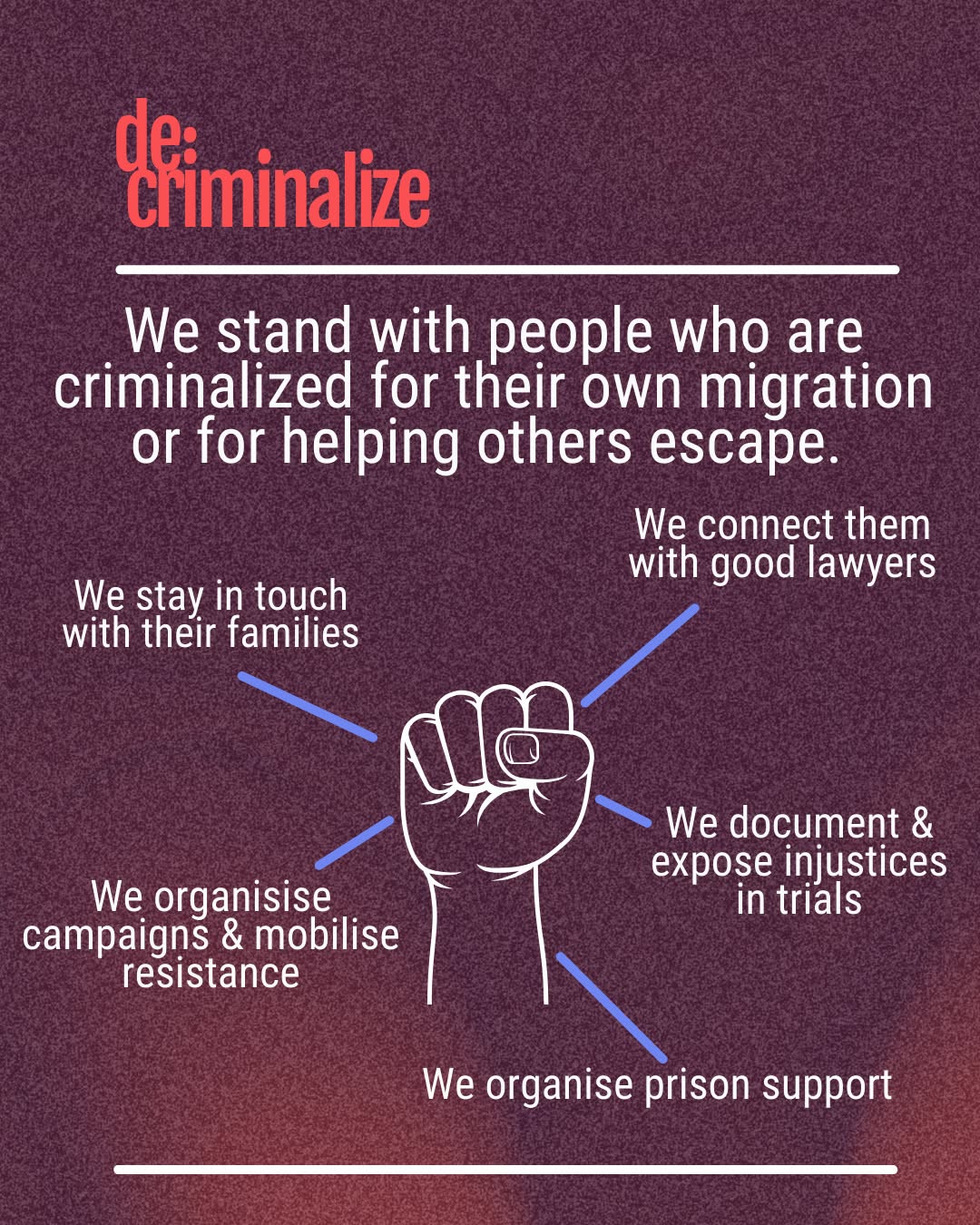
De:criminalize : What We Do. "We stand with people who are criminalized for their own migration or for helping others escape. We stay in touch with their families. We connect them with good lawyers. We document and expose injustices in trials. We organise campaigns and mobilise resistance. We organise prison support." (Image : ©De:criminalize)
Are there translators in de:criminalize or you work with translators there ?
We mostly communicate in English with the lawyers and the people we support, and for most other languages we have to rely on online translators or the help of friends and comrades. We also have native Italian and Spanish speakers among us, which is helpful for cases in Italy and Spain, and one of us speaks Arabic. For communication with courts and other official institutions, however, it is mandatory to use the country’s official language.
I understand that you can help by providing lawyers, but are you also, for example, suing when minors are incarcerated with adults ? I am thinking about how France is regularly condemned by the European Court of Human Rights for prison conditions or police brutality, for reference.
We have not done that yet, and I don’t know what our chances would be in that regard. But that is a valid question, and I assume the legal grounds for that would be given.
I agree that it would be a very strong sign as to the legal and moral condemnability of these practices. Recently, there have been some cases where the birth certificates of criminalized people were accepted as proof of their being underage, but oftentimes they cannot be provided or are not accepted. Usually the age assessments are carried out based on wrist examinations. Challenging the incorrect age assessments and trying to provide birth certificates is regularly part of the defense strategy in these cases. However, it often proves difficult to obtain (original) certificates, especially for people from South Sudan or Sudan, who have often been displaced many times already before arriving in Europe. In very few cases, it has been successful, and recently one person has been released from the prison into a camp to be tried by a juvenile court. However, the Greek judicial benches still usually favour the controversial wrist measuring age assessments, which are widely known and criticized to be inaccurate.
It is actually quite complicated to escalate a case to the European Court of Human Rights, as it first has to pass all ‘lower’ and national courts. This costs a lot of money, time and capacities. One person we have supported has chosen this route, in order to prove that this criminalization undermines the right to seek asylum, not for a minor case. This has not been successful so far.
What happens when people are not convicted or after they have served and been released? What do they do, where do they go, what possibilities do they have ?
That is a very important question. Those who are acquitted usually don’t get any kind of compensation, even if they have spent a long time in pretrial detention. We have also documented several cases, especially on Crete, where people have not been released from the police station for months following their acquittal by a court. There are no legal reasons to continue their detention, but often, a lawyer had to fight for their release. In one case, an acquitted person who had applied for asylum was denied the documents proving his acquittal and essentially threatened with deportation, despite his family also being in an asylum procedure in Greece. In other cases, people did not receive any information on how to apply for asylum, and are consequently also threatened with deportation or immediately detained again because they don’t have residence permit.
Of course, a conviction and sentence in a Greek prison have a severe impact on a person’s life and psychological condition. It can influence the asylum procedure (especially if it is still undertaken while imprisoned) and people risk being deported after having served the sentence (this is especially the case for so-called safe countries of origin, like Turkey or Egypt). Apart from that, they might find themselves undocumented, which implies enormous difficulties on a number of levels, like housing, healthcare, etc. This also leads us back to the question of plea-deals, which many defendants have recently been pressured to sign, without being given sufficient information on the consequences of this decision or even without being provided a translation of what they sign. A plea deal is essentially a confession of guilt in return to which the prosecution will (supposedly) lower the sentence. In practice they often receive the same sentences as through trial. However, if someone signs a plea deal, they are no longer able to a) be acquitted, b) appeal the decision, or c) apply for asylum. For the Greek courts, this might seem like a fast and easy solution, but for the people who are accused of ‘smuggling’, signing a plea deal under pressure can have very negative long-term effects.
Would you say that the goal of these policies is to traumatize people on the move and to discourage any kind of movement ?
That is hard to answer, but I would argue that discouraging people from migrating to Europe seems to be the long-term goal of these policies. Traumatizing and killing people seems to be accepted as a means to reach this goal by the European Union. On the other hand, two of our group members have tried to analyze the structural reasons behind this criminalization in a recent article for the Rosa Luxemburg Stiftung and argued that the ultimate goal of the militarized European border regime is the systematic undermining of the right to asylum.
Does the Greek population know about these trials ? What are their opinions and are there Greek people involved in de:criminalize ?
I think the extent to which the Greek population is informed about these trials is hard to assess. From our Greek comrades, we know that even within the left-leaning circles, the situation is not very well known. However, the Greek media does pay close attention in the event of major massacres, such as the Pylos shipwreck, because in such cases they often look for scapegoats and accuse people on the move. It seems to be difficult to effectively subvert the public discourse around migration — not only in Greece —, to move it away from the narrative around ‘smuggling’ and towards the acknowledgment and termination of these blatant human rights violations. We think that our struggle needs to be directed more decisively at this shift of the discourse.
What would you say about the weight, the toll that doing this work takes and how do the members of de:criminalize experience and manage it?
I think this question can be addressed to anyone involved in social justice struggles, and we all experience this differently. At the same time, we are aware that we are not the ones directly oppressed by the systems we challenge, and we aim not to frame our involvement as rescuing. For us, the work is meaningful not because it ‘empowers’ us personally, but because it allows us to respond to injustice and stand in solidarity with those who are affected.
Interview by Cases Rebelles on February 12, 2026.
We would like to extend our heartfelt thanks to Florentine and de:criminalize members.
To follow, contact and/or support de:criminalize : https://decriminalize.eu/en/home-en/ et https://www.instagram.com/de.criminalize/
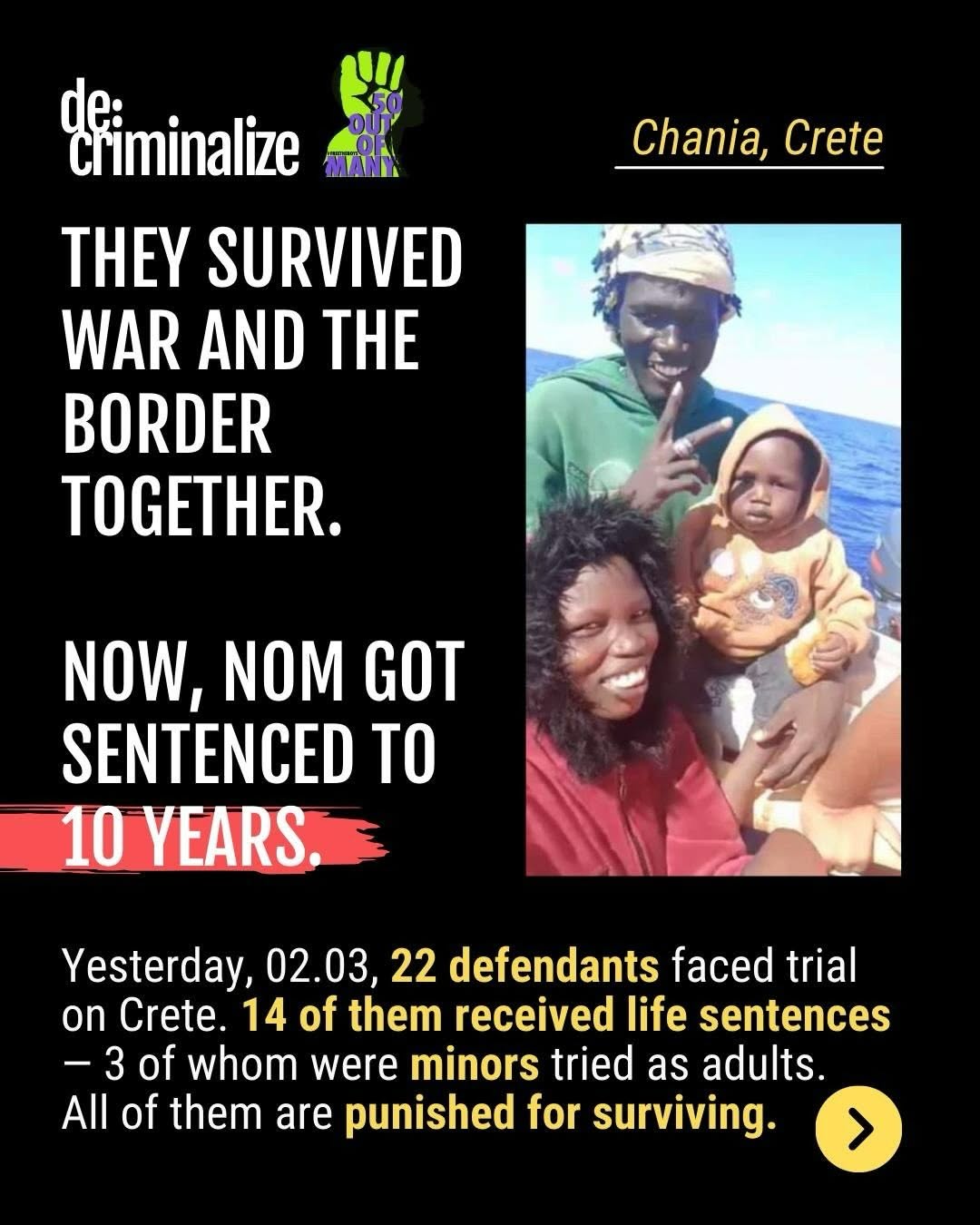
De:criminalize : Chania, Crete. They survived war and the border together. Now, Nom got sentenced to 10 years. Yesterday, 2 mars, 22 defendants faced trial on Crete. 14 of them received life sentences - 3 of whom were minors tried as adults. All of them are punished for surviving. (Image : ©De:criminalize)
A lire / écouter également :
 En Grèce, la machine à criminaliser les exilé·es
 Of Anger and disappointment : An interview about the renewal of the Memorandum of Understanding Italy-Libya
 « Cette plainte veut dire qu’on leur fait très mal, qu’ils ne savent plus quoi faire » : Interview avec Assa Traoré
 Épisode n°113 | Salahdine Juma, de Refugees In Libya : « C’est notre devoir de parler au reste du monde »
Une réflexion au sujet de « In Greece, the machine to criminalize people on the move »
Les commentaires sont fermés.